How to learn Norwegian by reading stories: a 15-minute routine
このページは英語とノルウェー語で提供しています。
One story, six steps, about fifteen minutes. Pick a story where you can follow what happens and only a few words per paragraph stop you, then do this:
Get the gist1 min
Read the title and, if you like, open the quick summary. Guess what will happen.
Read once without stopping4 min
Follow the plot. Skip unknown words unless the sentence stops making sense; many become clear a line later.
Read again, look up a few words4 min
Tap only the words that really block you for a translation and a short explanation. New lookups need a free account, and the explanations are AI-generated, so they can be wrong.
Listen2–3 min
Play the audio and follow the highlighted word.
Check yourself2 min
Take the short quiz. Missed a question? Find the sentence with the answer.
Keep three to five words1 min
Tap Save word (free account). Each word is stored with the sentence it came from on your saved words page.
Busy day? Steps 2 and 4 alone are still worth doing.
Find your level in one story
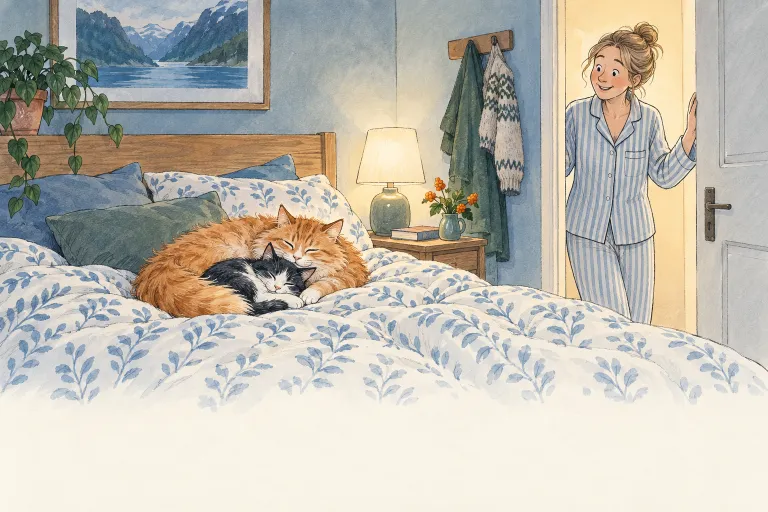
Katten min
Jeg har en katt. Han heter Mons. Mons er liten, svart og hvit.
“I have a cat. His name is Mons. Mons is small, black and white.” If this opening is easy, try the next one.
Read free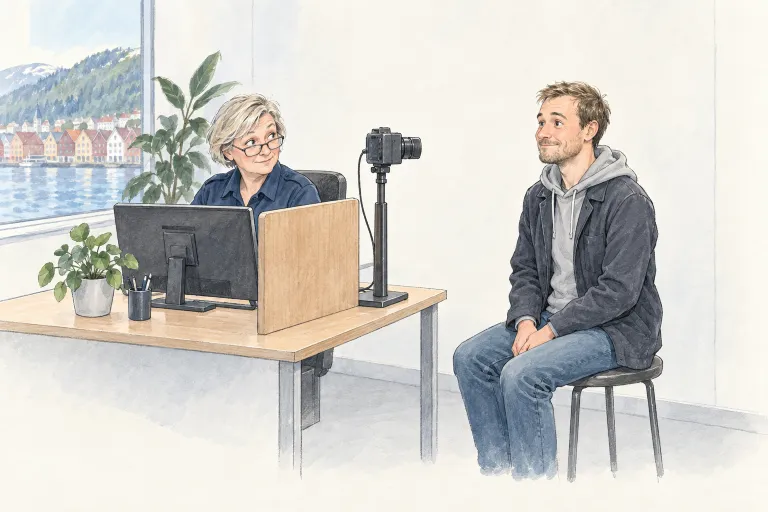
Passbildet
Dmitri hadde ventet på svar i nesten to år. Nå satt han på en stol hos politiet i Bergen.
“Dmitri had been waiting for an answer for almost two years. Now he was sitting on a chair at the police station in Bergen.” Past tense, longer sentences. If this works with a little effort, read at A2.
Read freeEach level is split into easy, medium and hard stories, so you can move up in small steps. If you look something up in nearly every sentence, go easier; if nothing is new, move up.
Collect phrases, not just words
Guess what each line means, then tap it. All four come from free A1 stories.
«Hva skal det være?»Tap to see what it means
“What can I get you?” The fishmonger asks it in Sju eller sytti?, and you will hear it in shops and cafés.
«Han tar på seg jakka og går til butikken.»Tap to see what it means
“He puts on his jacket and goes to the shop.” Å ta på seg means “to put on” clothes; tar on its own is just “takes”. From Søndag.
«Unnskyld, vet du når bussen til sentrum går?»Tap to see what it means
“Excuse me, do you know when the bus to the centre leaves?” A polite opener you can reuse anywhere. From Når går bussen?
«Takk for maten!»Tap to see what it means
“Thanks for the meal.” Said to the host after eating, as a neighbour does at the end of Sju eller sytti?
Notice one pattern: the verb comes second
Pick one pattern per story. Word order is a good first one. In a Norwegian statement the verb sits in second place, whatever comes first:
When the sentence starts with a time or a place, the subject (han, naboene) moves after the verb. Once you have seen it, you will spot it in almost every story.
A week that fits around real life
- MondayNew storyThe whole routine.
- TuesdayAgainRe-read Monday’s story, then listen once without the text.
- WednesdayNew storyThe whole routine.
- ThursdayWordsGo through your saved words and their sentences.
- FridayNew storyThe whole routine.
- WeekendAgainRead a favourite aloud along with the audio.
Re-reading shows you your progress: sentences that were slow should now flow. If a re-read still feels like hard work, make the next new story a step easier. And missing a day doesn’t matter; a short habit you keep beats a long session you keep putting off.